by Adam Metz
What I remember most about attending the 50th annual Thanksgiving Day football game in Detroit back in 1989 was the Cleveland Browns hearse that was in the tailgating lot. You read that correctly – an orange and brown hearse decked out with a white stripe down the middle. I can't be certain, but there's a pretty good chance that it is the same Cleveland Browns hearse that was for sale on Craigslist earlier this year. (Can there be more than one?) Anyone who has ever attended a big-time sporting event can attest to the bizarre things fans will do to show their support for their team. From awkward tattoos to hilarious obituaries to all out riots, sports can bring out the best, the worst, and the weirdest in us all.
As a high school football official for the past ten years, one of things I have realized about sports is that it makes people irrational. My football crew and I have had pleasant conversations with coaches who seem completely sane before the game, only to watch them turn into rude, degrading, and screaming imbeciles in a matter of minutes. Coaches, players, and, especially fans, under the intoxicating influence of sports can quickly do or say things that they will regret - sometimes for the rest of their lives.
Sports not only affects our actions, however; our minds are just as susceptible to its influence. In January 2003, my wife and I were in Tempe, AZ with another couple to watch Ohio State take on the University of Miami in the National Championship game. If you remember it, this was one of the greatest college games ever played, and Ohio State won in double overtime. If you are a Miami fan (as was the other couple attending the game with my wife and I), you certainly remember that the first overtime was extended by a controversial defensive pass interference call against Miami. You can relive the drama in this fine piece of Buckeye propaganda. With my friend and I rooting for opposing outcomes of this game, it was fascinating to watch the "thrill of victory" and the "agony of defeat" live itself out in the two of us, as Ohio State was recognized the victor. The difference between our two experiences could not have been greater.
 It wasn't just the feeling of victory and defeat however, that made for contrast in our reactions. As we talked after the game, it became apparent that we saw a different game. A close call that had to be made (in my opinion) was a total miscall and display of incompetence (in my friend's opinion). And yet, we’d sat right next to one another; we saw the same game. We're both intelligent and generous people, not quick to make accusations against others. How could he be so wrong?
I finally found some answers when I ran across a psychology study that had been published nearly 60 years ago and examined a situation just like this. The name of the study is "They Saw a Game: A Case Study" and studies fans who attended the November 23, 1951 Dartmouth-Princeton football game. They asked fans from both schools questions about the dirty play in the game and who was responsible for starting it. Across the board, students were more likely to believe that the other team’s players initiated it, and that their team was simply (and justifiably) responding. Even the way the two schools' newspapers reported the game differed greatly. The findings led authors Hastorf and Cantril to conclude, "the 'game' actually was many different games and . . . each version of the events that transpired was just as 'real' to a particular person as other versions were to other people."
The study highlighted what is known as "selective perception," and the anecdotal references of ugly tattoos, NFL colored hearses, and sports biases highlight the fact that sports often has a power over all of us - even over our minds. Sports fanatics often live completely different lives at the office or at home in the "real world." The arena or the stadium is a place where they can "let it all hang out" and "blow off some steam."
Sports allegiances can also blind us, however. It does more than alter our perception of close calls. They can sometimes lead us to cheer when a player goes down with an injury. They can make us say things we would never say on the street or in any other setting. The first football chant I remember hearing as a kid was, "Elway's a faggot." Really, I heard 80,000 fans chant that in unison. In short, our sports allegiances can cause us to lose who we are.
That's the only way I can explain what happened on this past Saturday's episode of the wildly popular College Game Day. If you aren't familiar with Game Day, it is basically a televised tailgate party that travels each week to different locations in order to help get the country excited about upcoming college football games. Each week, the show builds suspense as the personalities make their picks for the big game, and climaxes when former college football coach Lee Corso makes his "head gear" pick for the game from which they broadcast by putting on the mascot of the team he is picking. This past Saturday's game was in South Carolina for the Florida State - Clemson game, and Corso picked Florida State. You have to see it to really capture what happened next; you can watch it here.
It wasn't just the feeling of victory and defeat however, that made for contrast in our reactions. As we talked after the game, it became apparent that we saw a different game. A close call that had to be made (in my opinion) was a total miscall and display of incompetence (in my friend's opinion). And yet, we’d sat right next to one another; we saw the same game. We're both intelligent and generous people, not quick to make accusations against others. How could he be so wrong?
I finally found some answers when I ran across a psychology study that had been published nearly 60 years ago and examined a situation just like this. The name of the study is "They Saw a Game: A Case Study" and studies fans who attended the November 23, 1951 Dartmouth-Princeton football game. They asked fans from both schools questions about the dirty play in the game and who was responsible for starting it. Across the board, students were more likely to believe that the other team’s players initiated it, and that their team was simply (and justifiably) responding. Even the way the two schools' newspapers reported the game differed greatly. The findings led authors Hastorf and Cantril to conclude, "the 'game' actually was many different games and . . . each version of the events that transpired was just as 'real' to a particular person as other versions were to other people."
The study highlighted what is known as "selective perception," and the anecdotal references of ugly tattoos, NFL colored hearses, and sports biases highlight the fact that sports often has a power over all of us - even over our minds. Sports fanatics often live completely different lives at the office or at home in the "real world." The arena or the stadium is a place where they can "let it all hang out" and "blow off some steam."
Sports allegiances can also blind us, however. It does more than alter our perception of close calls. They can sometimes lead us to cheer when a player goes down with an injury. They can make us say things we would never say on the street or in any other setting. The first football chant I remember hearing as a kid was, "Elway's a faggot." Really, I heard 80,000 fans chant that in unison. In short, our sports allegiances can cause us to lose who we are.
That's the only way I can explain what happened on this past Saturday's episode of the wildly popular College Game Day. If you aren't familiar with Game Day, it is basically a televised tailgate party that travels each week to different locations in order to help get the country excited about upcoming college football games. Each week, the show builds suspense as the personalities make their picks for the big game, and climaxes when former college football coach Lee Corso makes his "head gear" pick for the game from which they broadcast by putting on the mascot of the team he is picking. This past Saturday's game was in South Carolina for the Florida State - Clemson game, and Corso picked Florida State. You have to see it to really capture what happened next; you can watch it here.
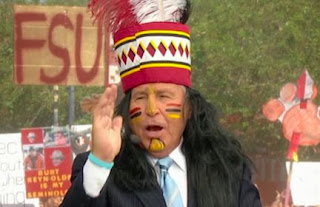 Without the context of college football, it's difficult to imagine anyone not seeing the offensive nature of this 60-second clip. This goes too far even for a Saturday Night Live sketch. But, since it was all in the spirit of college football, it passes with hardly a blip.
I scarcely side with the hyper-sensitive, politically correct world that is often forced upon us. Every year when my family attends the Opening Day festivities in Cleveland, OH, I am reminded that my favorite baseball team has bigoted roots. Having seen many misuses and overreactions, I tend to be slow and methodical in crying "racist," but this episode highlights the blinding power of sports. If Corso's getup wasn't enough to trip the sensitivity wire by the ESPN suits, didn't the body slamming by the white man (Bill Murray) at the end do it for them? That we can be so blind highlights yet again just how powerful sports can be.
This is a complicated topic and I'm making no claim to solving the issues with a single blog post. The discussion regarding the Washington Redskins continues to grow (the Huffington Post has an entire page devoted to stories about the controversy), Florida State is regularly in conversation with the Seminole Indians and are trying to appease their detractors, and I suppose discussions will broaden regarding the fates of the Cleveland Indians and Atlanta Braves and other similarly named teams. While the complex debate continues, a good place to begin is by acknowledging how sports clouds our judgment. We need to have these conversations, and we need to begin them by acknowledging that we are talking about people - a people who have been victimized and ignored as much as any civilization in the history of the world. And in a more perfect world, we would be having these conversations about football and baseball mascots because we had already acknowledged their painful past, restored dignity to their people, and assigned the value that is due to their civilizations.
Adam
is the minister of the Alum Creek Church of Christ in Lewis Center, OH
where he lives with his wife Mary Beth and their three children: Clark,
Clementine, and Cecilia. You can find more of his writing at Theological Vacillation and you can follow him on Twitter @CrasslyYours.
Without the context of college football, it's difficult to imagine anyone not seeing the offensive nature of this 60-second clip. This goes too far even for a Saturday Night Live sketch. But, since it was all in the spirit of college football, it passes with hardly a blip.
I scarcely side with the hyper-sensitive, politically correct world that is often forced upon us. Every year when my family attends the Opening Day festivities in Cleveland, OH, I am reminded that my favorite baseball team has bigoted roots. Having seen many misuses and overreactions, I tend to be slow and methodical in crying "racist," but this episode highlights the blinding power of sports. If Corso's getup wasn't enough to trip the sensitivity wire by the ESPN suits, didn't the body slamming by the white man (Bill Murray) at the end do it for them? That we can be so blind highlights yet again just how powerful sports can be.
This is a complicated topic and I'm making no claim to solving the issues with a single blog post. The discussion regarding the Washington Redskins continues to grow (the Huffington Post has an entire page devoted to stories about the controversy), Florida State is regularly in conversation with the Seminole Indians and are trying to appease their detractors, and I suppose discussions will broaden regarding the fates of the Cleveland Indians and Atlanta Braves and other similarly named teams. While the complex debate continues, a good place to begin is by acknowledging how sports clouds our judgment. We need to have these conversations, and we need to begin them by acknowledging that we are talking about people - a people who have been victimized and ignored as much as any civilization in the history of the world. And in a more perfect world, we would be having these conversations about football and baseball mascots because we had already acknowledged their painful past, restored dignity to their people, and assigned the value that is due to their civilizations.
Adam
is the minister of the Alum Creek Church of Christ in Lewis Center, OH
where he lives with his wife Mary Beth and their three children: Clark,
Clementine, and Cecilia. You can find more of his writing at Theological Vacillation and you can follow him on Twitter @CrasslyYours.
You can follow On Pop Theology on Twitter @OnPopTheology or like us on Facebook at www.facebook.com/OnPopTheology.
You might also like:
 by Adam Metz
If I close my eyes I can still smell the roast in the oven. Grandpa had one special meal that he made for our family on holidays - a Midwestern recipe handed down through the Great Depression: one arm roast, one loaf of bread, one medium-sized onion, one egg, salt and pepper to taste, and the rest of the pan filled with potatoes. My grandmother fell victim to cancer long before I took a breath, so instead we all grew up on Grandpa's cooking - at least on special occasions. We just called it Grandpa's roast and dressing.
For our family, Grandpa's roast and dressing was a sacred meal and the corresponding family time was a sacred gathering. Memories of bygone civic holidays and Thanksgiving and Christmas continue to stimulate the olfactory nostalgia of the roast in the oven. We would fill our plates and with our first bite, each of us would let Grandpa know how good it was. And it was always good.
More times than not, the sacred gathering commenced at 1:00 on Sunday afternoons. If there was a holy time in our family it was 1:00 on Sundays . . . after church. The secret ingredient to Grandpa's roast and dressing wasn't the onion or the egg; I think it was the orange helmets and the brown jerseys on his television. For our family, autumn Sundays were holidays because they were football Sundays.
My Grandpa instilled in me a love for football. He never played. He never coached. Far removed from the violent and aggressive nature of football, Grandpa was the gentlest of men. But he loved football, and more than football itself, he loved the Cleveland Browns - a love that he has bequeathed to me.
by Adam Metz
If I close my eyes I can still smell the roast in the oven. Grandpa had one special meal that he made for our family on holidays - a Midwestern recipe handed down through the Great Depression: one arm roast, one loaf of bread, one medium-sized onion, one egg, salt and pepper to taste, and the rest of the pan filled with potatoes. My grandmother fell victim to cancer long before I took a breath, so instead we all grew up on Grandpa's cooking - at least on special occasions. We just called it Grandpa's roast and dressing.
For our family, Grandpa's roast and dressing was a sacred meal and the corresponding family time was a sacred gathering. Memories of bygone civic holidays and Thanksgiving and Christmas continue to stimulate the olfactory nostalgia of the roast in the oven. We would fill our plates and with our first bite, each of us would let Grandpa know how good it was. And it was always good.
More times than not, the sacred gathering commenced at 1:00 on Sunday afternoons. If there was a holy time in our family it was 1:00 on Sundays . . . after church. The secret ingredient to Grandpa's roast and dressing wasn't the onion or the egg; I think it was the orange helmets and the brown jerseys on his television. For our family, autumn Sundays were holidays because they were football Sundays.
My Grandpa instilled in me a love for football. He never played. He never coached. Far removed from the violent and aggressive nature of football, Grandpa was the gentlest of men. But he loved football, and more than football itself, he loved the Cleveland Browns - a love that he has bequeathed to me.
 I learned to love the Browns so much that when I moved away from Ohio, people assumed I grew up in Cleveland. Cleveland was over a hundred miles away from Defiance, but for three hours each week our house might as well have stood on the shores of Lake Erie. We cheered for the Buckeyes, we didn't hate the Lions or the Colts, but there was no mistaking that we were a Browns family. Through and through.
That's what made January 17, 1988 so hard. Maybe it was because we failed to partake of the sacred meal on that fateful Sunday afternoon. Maybe it was because we felt that devastation and misery could never befall us two years in a row. But whatever the reason, on that day over 25 years ago, the football gods decided to urinate on the city of Cleveland and on Grandpa's house in Defiance.
The memories of an eight-year-old, 25 years removed, are far from reliable, but whenever I do remember that day it was always dark. Through the darkness I remember that we recorded the game on our VCR so that we could relive the big victory over and over again. I remember that the Browns were playing the Denver Broncos in the AFC Championship game for the second consecutive year. I remember that if the Browns won, they were finally going to go to play in their first Super Bowl. I remember that John Elway had devastated us the year prior with what NFL lore has termed The Drive. I remember thinking that it was going to be different this year, that this was our year.
I know that with 1:12 remaining on the clock in the fourth quarter, the Browns were behind by a touchdown but had the ball at Denver's eight-yard-line.
I know that Bernie Kosar handed the ball off to Earnest Byner.
I know he got hit hard by Broncos linebacker Jeremiah Castille at the two-yard-line.
I learned to love the Browns so much that when I moved away from Ohio, people assumed I grew up in Cleveland. Cleveland was over a hundred miles away from Defiance, but for three hours each week our house might as well have stood on the shores of Lake Erie. We cheered for the Buckeyes, we didn't hate the Lions or the Colts, but there was no mistaking that we were a Browns family. Through and through.
That's what made January 17, 1988 so hard. Maybe it was because we failed to partake of the sacred meal on that fateful Sunday afternoon. Maybe it was because we felt that devastation and misery could never befall us two years in a row. But whatever the reason, on that day over 25 years ago, the football gods decided to urinate on the city of Cleveland and on Grandpa's house in Defiance.
The memories of an eight-year-old, 25 years removed, are far from reliable, but whenever I do remember that day it was always dark. Through the darkness I remember that we recorded the game on our VCR so that we could relive the big victory over and over again. I remember that the Browns were playing the Denver Broncos in the AFC Championship game for the second consecutive year. I remember that if the Browns won, they were finally going to go to play in their first Super Bowl. I remember that John Elway had devastated us the year prior with what NFL lore has termed The Drive. I remember thinking that it was going to be different this year, that this was our year.
I know that with 1:12 remaining on the clock in the fourth quarter, the Browns were behind by a touchdown but had the ball at Denver's eight-yard-line.
I know that Bernie Kosar handed the ball off to Earnest Byner.
I know he got hit hard by Broncos linebacker Jeremiah Castille at the two-yard-line.
 I know Byner fumbled the football six feet short of scoring a game-tying touchdown.
I know that the Broncos recovered the fumble.
I know that Grandpa pushed "Stop" on the VCR to end the recording.
I know that we never watched that game again.
I know that 25 years later, the Cleveland Browns still have never been to the Super Bowl.
A few years ago Bill Simmons wrote an article attempting to enumerate the most cursed sports franchises in America. He put the Browns at number four, behind the Bills, the Vikings, and, the darling of all futile sports teams, the Cubs. The fact that Cleveland's other two professional sports teams make the same list in the top ten easily makes Cleveland the most cursed sports city in the country. Why do we do this to ourselves? Why did Grandpa do this to me?
It was a little surreal going through Grandpa's things after he died in February. His health had been failing for quite some time, so he had already gotten rid of most of his material possessions. It's safe to say that most of what was left was the stuff he really wanted to hold on to. Not surprisingly most of what we found had an orange helmet on it or was trimmed in brown. There's a mini Riddell helmet that sat in his living room for all those games of heartbreak we endured together. It's found a new home now in my office.
I will forever be struck by the irony of the fact that the last football game my grandpa ever watched was the 47th consecutive Super Bowl that the Browns weren't playing in. And the last Super Bowl champion he ever saw was the team that used to be the Browns . . . that team whose name shall not be mentioned in an article about my grandpa.
I know Byner fumbled the football six feet short of scoring a game-tying touchdown.
I know that the Broncos recovered the fumble.
I know that Grandpa pushed "Stop" on the VCR to end the recording.
I know that we never watched that game again.
I know that 25 years later, the Cleveland Browns still have never been to the Super Bowl.
A few years ago Bill Simmons wrote an article attempting to enumerate the most cursed sports franchises in America. He put the Browns at number four, behind the Bills, the Vikings, and, the darling of all futile sports teams, the Cubs. The fact that Cleveland's other two professional sports teams make the same list in the top ten easily makes Cleveland the most cursed sports city in the country. Why do we do this to ourselves? Why did Grandpa do this to me?
It was a little surreal going through Grandpa's things after he died in February. His health had been failing for quite some time, so he had already gotten rid of most of his material possessions. It's safe to say that most of what was left was the stuff he really wanted to hold on to. Not surprisingly most of what we found had an orange helmet on it or was trimmed in brown. There's a mini Riddell helmet that sat in his living room for all those games of heartbreak we endured together. It's found a new home now in my office.
I will forever be struck by the irony of the fact that the last football game my grandpa ever watched was the 47th consecutive Super Bowl that the Browns weren't playing in. And the last Super Bowl champion he ever saw was the team that used to be the Browns . . . that team whose name shall not be mentioned in an article about my grandpa.
 There's a lot about football that bothers me. It is utterly ridiculous that I invest so much money and, especially, so much emotional capital into whether or not my sports teams are successful. There's a lot about the American obsession with football that is troubling. Anything as big and as powerful as the sport of football is sure to be riddled with flaws. Amidst the billion dollar contracts, sold out college and NFL stadiums, and off-the-charts television ratings, it's sometimes easy to ignore football's dark side. Persistent player arrests, devastating injuries having become widespread, and chronic post-concussion symptoms highlight that there is much that football must improve. The very quarterback from that 1987 AFC Championship and my childhood hero, Bernie Kosar, serves as a poster child for the dark side of football. Recently, Kosar has had some very public embarrassments, attributed to his many concussions.
But in our haste to condemn the ills of football, we should be cautious not to overlook the beauty of this game. As the Cleveland Browns take the field on September 8, 2013 against the Miami Dolphins I will once again put on my Browns jersey. 1:00 pm. Sunday afternoon. Holy time.
I'm older now and I watch the game differently than I did back in the 1980's. The game itself is actually quite a bit different from what it was in the 1980's. Our family is dispersed so we no longer have a regular holy family gathering, and we will have to find a new way to celebrate the holy meal. And for the first time in my 34 years, I won't be able to talk to Grandpa about football.
The odds-makers say the Browns are a 60-1 shot for winning the Super Bowl, but I plan to root them on as if they were the favorite. There's a lot wrong with football, and I'll spend a good deal of my time focusing in on that. But what's right about football is that it helps usher in some of my fondest memories sitting alongside my grandpa cheering on our team - a team that happens to lose more times than it wins. Maybe sports is about more than winning and losing after all. It has to be, or I would have given up on the Browns a long time ago. I wish I could ask Grandpa what he thinks about that.
Adam is the minister of the Alum Creek Church of Christ in Lewis Center, OH where he lives with his wife Mary Beth and their three children: Clark, Clementine, and Cecilia. You can find more of his writing at Theological Vacillation and you can follow him on Twitter @CrasslyYours.
There's a lot about football that bothers me. It is utterly ridiculous that I invest so much money and, especially, so much emotional capital into whether or not my sports teams are successful. There's a lot about the American obsession with football that is troubling. Anything as big and as powerful as the sport of football is sure to be riddled with flaws. Amidst the billion dollar contracts, sold out college and NFL stadiums, and off-the-charts television ratings, it's sometimes easy to ignore football's dark side. Persistent player arrests, devastating injuries having become widespread, and chronic post-concussion symptoms highlight that there is much that football must improve. The very quarterback from that 1987 AFC Championship and my childhood hero, Bernie Kosar, serves as a poster child for the dark side of football. Recently, Kosar has had some very public embarrassments, attributed to his many concussions.
But in our haste to condemn the ills of football, we should be cautious not to overlook the beauty of this game. As the Cleveland Browns take the field on September 8, 2013 against the Miami Dolphins I will once again put on my Browns jersey. 1:00 pm. Sunday afternoon. Holy time.
I'm older now and I watch the game differently than I did back in the 1980's. The game itself is actually quite a bit different from what it was in the 1980's. Our family is dispersed so we no longer have a regular holy family gathering, and we will have to find a new way to celebrate the holy meal. And for the first time in my 34 years, I won't be able to talk to Grandpa about football.
The odds-makers say the Browns are a 60-1 shot for winning the Super Bowl, but I plan to root them on as if they were the favorite. There's a lot wrong with football, and I'll spend a good deal of my time focusing in on that. But what's right about football is that it helps usher in some of my fondest memories sitting alongside my grandpa cheering on our team - a team that happens to lose more times than it wins. Maybe sports is about more than winning and losing after all. It has to be, or I would have given up on the Browns a long time ago. I wish I could ask Grandpa what he thinks about that.
Adam is the minister of the Alum Creek Church of Christ in Lewis Center, OH where he lives with his wife Mary Beth and their three children: Clark, Clementine, and Cecilia. You can find more of his writing at Theological Vacillation and you can follow him on Twitter @CrasslyYours.
You can follow On Pop Theology on Twitter @OnPopTheology or like us on Facebook at www.facebook.com/OnPopTheology.
You might also like:


 Without the context of college football, it's difficult to imagine anyone not seeing the offensive nature of this 60-second clip. This goes too far even for a Saturday Night Live sketch. But, since it was all in the spirit of college football, it passes with hardly a blip.

