A word of preface: this blog contains spoilers about episodes in Season 2 Doctor Who. If you haven’t seen them yet – get thee to a TV and watch first!
Cultures across human history have struggled with the problem of evil. From vindictive gods who must be appeased, to hoards of supernatural demons tempting the unwary away from the righteous path, evil is the topic of much mythical and theological deliberation. The persistence and origin of evil, particularly in the post-Enlightenment era, continues to perplex theologians and philosophers alike. And, so too, the wrestling with this problem of evil continues as well, and is taken up by the science fiction cult phenomenon Doctor Who.
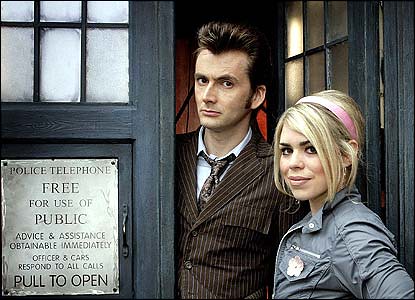
In the pair of episodes from season 2, “The Impossible Planet” and “The Satan Pit,” the Tenth Doctor and his companion Rose, encounter a planet somehow suspended just within the reach of a black hole. A legend tells that this black hole had once swallowed the planet up, but then spit it out again, giving rise to the planet’s name “The Bitter Pill.” Upon this impossible planet, the Doctor and Rose encounter a crew of scientists, drilling to the center and looking for the source of incomparable energy which is radiating out across the universe from the planet’s center and somehow keeping it from being swallowed again1.
After the station is rocked by several earthquakes, the crew is plagued by a series of violent possessions, and the Doctor discovers a malevolent alien chained at the planet’s core. The alien, a great, horned beast chained in a pit of fire, confirms to the Doctor that he is the root of every mythic devil-figure in every culture across the universe. Imprisoned in the planet’s core, the beast uses telepathy to transmit the concept of embodied evil across the stars, possessing crew member Toby in a bid to escape his pre-historic prison. Of course the Doctor, in his brilliant, whimsical way, is able to defeat the alien monster by plunging the planet into the black hole. The Doctor swoops in on the TARDIS just in time to rescue the remaining members of the crew and his beloved companion Rose, before whisking them away from the yawning mouth of the black hole’s abyss. Cue the Doctor Who closing theme.
Well, then. What does this have to say about the problem of evil? Rather a lot, actually.
 For starters, we have to remember that at this point, Russell T Davies was the head writer, and an ardent and vocal atheist. He was clear in several episodes that he was challenging long-accepted religious (particularly Christian) tenets. In “The Satan Pit,” the Doctor gives a monologue in which he asserts that there are no true “gods” as such:
DOCTOR: So that’s the trap. Or the test, or final judgment, I don’t know. But if I kill you, I kill her. Except that implies in this big grand scheme of Gods and Devils that she’s a victim. But I’ve seen a lot of the universe. I’ve seen fake gods and bad gods and demi-gods and would-be gods, and out of all of that whole pantheon, if I believe in one thing, just one thing, I believe in her.
In his monologue, the Doctor declares that there are no true gods – not in the sense of any ultimate Creator or all-knowing deity. There are only false impressions of would-be deity impersonators in a world governed by science. In fact, when the Beast claims to have been imprisoned before the universe began – before time itself – the Doctor rejects his claim for it defies his truth of science and reason. “Is this your religion?” the Beast asks the Doctor, who responds with, “It’s a belief.”
The back and forth between the Beast, the origin of much great evil, and the Doctor, who is characterized by ultimate good (although, those of you who follow the show know that it is a shadowy sort of good, marked by imperfections) asserts 2 points:
1. there are no universal religious truths, insofar as even science can be categorized as religion (there are only beliefs)
2. that evil is real, and the representations of supernatural evil in every mythic incarnation are the result of an ancient alien being chained in the heart of a planet suspended in orbit around a black hole.
There is no intentional “God.” But supernatural evil can be pinned to the first cause, a brutal, power-hungry, violent Satan-like telepathic monster. The show doesn’t posit that all evil is a result of this ancient alien. Episodes like “Rise of the Cybermen” and “Age of Steel” (also Season 2), are parables of how human weakness and greed lead to acts of incomprehensible evil (the slaughter of thousands of innocent victims in order to create an army of Cybermen).
But the show does make the claim that the eerily similar stories of a powerful supernatural evil – an evil which has the power to manipulate individuals into choosing the bad, giving into the pressures of fear, and causing general discord between people – is real and can be attributed to an ancient telepathic beast.
This seems almost laughable. For a show which has gone out of its way to create a god-free universe, to challenge notions of the supernatural, and to dismantle the power of myth, it seems like a weak way-out to simply exchange the idea of a fallen angel for an imprisoned telepathic alien. But precisely because such a show does not turn to “rational science” to explain away evil, we are confronted with just how complex the problem of evil still remains.
 Just as theologians have tried to make sense of how radical evil2 can exist in a world that Christians affirm was created good by a loving God, so too, these non-theist characters are trying to navigate how inexplicable, radical evil can exist in a world governed by science and the triumph of reason. Radical evil just doesn’t compute. St. Augustine believed fully that radical evil was the result of Satan, a fallen angel, who manipulated humans into terrifying acts. Karl Barth argued that evil, real evil, is actually nothingness (das Nichtige) which comes as the result of doing the opposite of God’s will. And, Process Theology wrestles with the theodicy question by limiting God’s power and saying that, “Yes, God is good, but God is not Almighty, and therefore evil is a result of human error without a divine corrective (because correction would be coercion).”
Ultimately, the problem and mystery of evil isn’t adequately explained by philosophers, theologians, or even the good Doctor himself. It’s hard to believe that any human being can become so sin-warped that he would entertain the idea of burning people in ovens; and yet, we are nevertheless faced with the grotesque horrors of the Holocaust. People report demon possession every year, and it manifests in ways which science can’t always ascribe to recorded forms of mental illness. We have biological fears of the dark; and we have biological fears, in many ways, of ourselves, fears which can be manipulated and result in great harm.
The problem of evil – of radical inexplicable evil – is a perennial one. By attributing supernatural evil (or influence to choose evil) to a prehistoric, telepathic alien monster imprisoned within a planet suspended in orbit around a black hole at the far reaches of the universe, Doctor Who is saying (like most theologians have said): we don’t really know. Why not an ancient telepathic alien? It makes as much sense as a fallen angel (which is to say, none).
Radical evil is precisely non-sensible. It doesn’t make sense. And while we try to wrestle with it, to find its’ first cause instead of just living with its unholy effects, we are left with philosophical wanking, and ancient myth. Truthfully, no one really knows where and why there is radical evil. But one thing is certain, it exists – even the Doctor accepts the fact that it exists. What becomes the issue worth spending a lifetime unpacking is this: what will we do, you and I, in the face of it?
1. I want to say that the curiosity of the human scientists is, in itself, worth discussing. But, that would be a digression from the topic of evil, so I’ll save it for another day!↩
2. I am making the distinction between “natural evil” – like a monsoon or cancer, which is the unfortunate result of a natural process – and “moral evil” – the evil as a result of human choices. When I say “radical evil” I am talking about the seemingly inhuman ways in which human beings create/perpetuate evil. The horrors of the Holocaust, or the Cambodia Killing fields are two examples of radical evil.↩
Laura Brekke is a woman of many names and many interests. When she is being a grown up, she directs Religious Diversity as a Catholic university in California. When she is being an academic, she ponders theological anthropology and popular culture. When she’s being a pastor, she writes a blog musing about faith, spirituality, and our reluctance to be vulnerable. And when she is just being herself, she proudly embraced her inner Whovian fangirl.
You can follow On Pop Theology on Twitter @OnPopTheology or like us on Facebook at www.facebook.com/OnPopTheology. If you'd like to support what we do here, you can donate via the button on the right of the screen.
Image Credits:
Image #1
Image #2
Image #3