Showing posts with label TV. Show all posts

Thursday, May 15, 2014

On TV Shows and Process


by Ben Howard

I know I’ve been good at hiding it, but I must confess that I’ve been in mourning this week. I lost something that was very close to me, something that brought me joy and laughter, something that I regarded it as a friend for the last five years. 

NBC cancelled Community.

You’ve probably heard about this already because you probably have that one friend who loved Community to an annoying degree and would never shut up about it and it kind of ticked you off. Or maybe you heard about it because you’re reading this on the internet, which is apparently the only place in the universe that Community was popular at all. #sixseasonsandamovie

But this is also the week for a lot of other news about the future of your TV consumption. This week came with announcements about future seasons of Nashville and Hannibal, the pick-up of new shows like The Flash, Gotham, and Agent Carter, and the end of several shows you never knew the names of (which is why they’re now cancelled). All of these announcements, including the cancellation of Community, are part of network Upfronts.

If you’ve never heard of Upfronts before, here’s a quick primer. Every year around this time, the major broadcast networks (NBC, ABC, CBS, Fox, and, curiously, The CW) unveil their new fall TV schedule in a series of elaborate press conferences designed to convince advertisers to purchase commercial time during all their new and returning shows. (And if you were born after 1990, a “commercial” is a short-film that used to show up all the time during moments of dramatic tension where someone would try to convince you to buy something.)
 
This year, something particularly interesting happened at Upfronts. Fox broke the mold for the way broadcast networks usually make TV shows. Fox stopped making pilots. Or at least, they stopped making a lot of them.

The process of getting a TV show to air is a rather long and arduous one. Networks pick from maybe 100 or 200 concept pitches and order pilot scripts for the shows they think sound promising. Any given network might order 50 or more scripts from which they’ll choose a few dozen to cast and shoot an actual episode. From this group of 20 to 25 pilots, they’ll select 5 or 6 new shows to air every year.

As you can probably imagine, producing all of these scripts and all of these pilots, is a rather expensive, not to mention inefficient, proposition. TV history is littered with highly-anticipated, expensive, star-studded pilots that never made it to air. Just in the last three years, there were pilots shot for Wonder Woman starring Adrianne Palicki (Tyra from Friday Night Lights), Beverly Hills Cop with Eddie Murphy, and just this year, a How I Met Your Mother spin-off called How I Met Your Dad headlined by indie darling Greta Gerwig. None of these shows made it to air.

But this year, Fox has adopted the cable model of making TV shows. You find a concept you really, really love. You give the creators a ton of time and money and a room full of writers and you let them hone their script and characters and vision for a show, a process of refining the material again and again until it’s finally ready to shoot. This is the process that produced Breaking Bad, Mad Men, and Game of Thrones among others.

And it’s a better process. It allows for focus and precision and dedication. It allows for depth, vision, and the opportunity for something like transcendence. That’s a lot harder to come by when you’re working in bulk, churning out dozens of rough drafts, and just hoping that something sticks.

This is the place where I would usually spin this into a metaphor for the church, for how we interact with each other in daily life, how dedication and focus on relationships matter. And while I do indeed find it to be an apt metaphor, I think you’ve probably already made those connections on your own without needing me to spell it out.

Instead, I want to point out something else entirely. Even though this is a definitively better process, it does not guarantee success. Even a good show with a lot of resources behind it can fall flat in the ratings like Terriers did a few years back on FX. Nor, for that matter, does this process guarantee quality. Smart, talented people can still put out a bad show like AMC did with Low Winter Sun. A better process, even the best process, is not a guarantee; there is no silver bullet.

But we want there to be. We prefer the logic that the perfect process will yield the perfect result (we have entire industries built on that premise), and we’re conditioned to assume that if we can just get the process right, the rest will fall into place. But that conditioning tricks us; if we expect success to flow systematically from process, we see failures as indictments of the whole system. We link them so closely that they sink or swim together. We base our assessment of the whole enterprise on the narrative of results.

Except results are prone to all sorts of uncontrollable circumstances, they are dependent on the relative nature of time and space and chance, things we couldn’t control even if we wanted to. And that’s why it’s so crucial to focus on a good process, the kind that allows for commitment and thoughtfulness. The kind we can believe in that makes room for new ideas, better ideas, and allows us to follow their call and see where they lead.

It doesn’t guarantee us success (whatever success might mean) and it doesn’t guarantee us quality, but it does give us a better shot. It allows us to be focused and dedicated. It allows us to have depth and vision. And maybe, just maybe, the opportunity for something like transcendence. 

Ben Howard is an accidental iconoclast and generally curious individual living in Nashville, Tennessee. He is also the editor-in-chief of On Pop Theology and an avid fan of waving at strangers for no reason. You can follow him on Twitter @BenHoward87.  


You can follow On Pop Theology on Twitter @OnPopTheology or like us on Facebook at www.facebook.com/OnPopTheology. If you'd like to support what we do here, you can donate via the button on the right of the screen.

Image Credits:
Image #1
Image #2
Image #3  
  
You might also like:  

Thursday, May 8, 2014

The Problem of Evil: Devils, Aliens and Doctor Who

by Laura Brekke

A word of preface: this blog contains spoilers about episodes in Season 2 Doctor Who. If you haven’t seen them yet – get thee to a TV and watch first!

Cultures across human history have struggled with the problem of evil. From vindictive gods who must be appeased, to hoards of supernatural demons tempting the unwary away from the righteous path, evil is the topic of much mythical and theological deliberation. The persistence and origin of evil, particularly in the post-Enlightenment era, continues to perplex theologians and philosophers alike. And, so too, the wrestling with this problem of evil continues as well, and is taken up by the science fiction cult phenomenon Doctor Who.

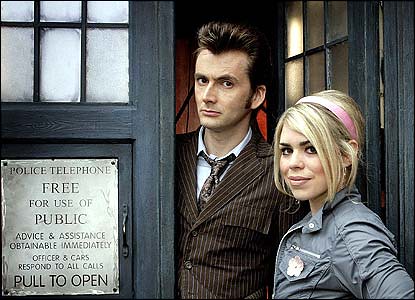
In the pair of episodes from season 2, “The Impossible Planet” and “The Satan Pit,” the Tenth Doctor and his companion Rose, encounter a planet somehow suspended just within the reach of a black hole. A legend tells that this black hole had once swallowed the planet up, but then spit it out again, giving rise to the planet’s name “The Bitter Pill.” Upon this impossible planet, the Doctor and Rose encounter a crew of scientists, drilling to the center and looking for the source of incomparable energy which is radiating out across the universe from the planet’s center and somehow keeping it from being swallowed again1.

After the station is rocked by several earthquakes, the crew is plagued by a series of violent possessions, and the Doctor discovers a malevolent alien chained at the planet’s core. The alien, a great, horned beast chained in a pit of fire, confirms to the Doctor that he is the root of every mythic devil-figure in every culture across the universe. Imprisoned in the planet’s core, the beast uses telepathy to transmit the concept of embodied evil across the stars, possessing crew member Toby in a bid to escape his pre-historic prison. Of course the Doctor, in his brilliant, whimsical way, is able to defeat the alien monster by plunging the planet into the black hole. The Doctor swoops in on the TARDIS just in time to rescue the remaining members of the crew and his beloved companion Rose, before whisking them away from the yawning mouth of the black hole’s abyss. Cue the Doctor Who closing theme.

Well, then. What does this have to say about the problem of evil? Rather a lot, actually.

For starters, we have to remember that at this point, Russell T Davies was the head writer, and an ardent and vocal atheist. He was clear in several episodes that he was challenging long-accepted religious (particularly Christian) tenets. In “The Satan Pit,” the Doctor gives a monologue in which he asserts that there are no true “gods” as such:

DOCTOR: So that’s the trap. Or the test, or final judgment, I don’t know. But if I kill you, I kill her. Except that implies in this big grand scheme of Gods and Devils that she’s a victim. But I’ve seen a lot of the universe. I’ve seen fake gods and bad gods and demi-gods and would-be gods, and out of all of that whole pantheon, if I believe in one thing, just one thing, I believe in her.

In his monologue, the Doctor declares that there are no true gods – not in the sense of any ultimate Creator or all-knowing deity. There are only false impressions of would-be deity impersonators in a world governed by science. In fact, when the Beast claims to have been imprisoned before the universe began – before time itself – the Doctor rejects his claim for it defies his truth of science and reason. “Is this your religion?” the Beast asks the Doctor, who responds with, “It’s a belief.”

The back and forth between the Beast, the origin of much great evil, and the Doctor, who is characterized by ultimate good (although, those of you who follow the show know that it is a shadowy sort of good, marked by imperfections) asserts 2 points: 

1. there are no universal religious truths, insofar as even science can be categorized as religion (there are only beliefs)

2. that evil is real, and the representations of supernatural evil in every mythic incarnation are the result of an ancient alien being chained in the heart of a planet suspended in orbit around a black hole.

There is no intentional “God.” But supernatural evil can be pinned to the first cause, a brutal, power-hungry, violent Satan-like telepathic monster. The show doesn’t posit that all evil is a result of this ancient alien. Episodes like “Rise of the Cybermen” and “Age of Steel” (also Season 2), are parables of how human weakness and greed lead to acts of incomprehensible evil (the slaughter of thousands of innocent victims in order to create an army of Cybermen).

But the show does make the claim that the eerily similar stories of a powerful supernatural evil – an evil which has the power to manipulate individuals into choosing the bad, giving into the pressures of fear, and causing general discord between people – is real and can be attributed to an ancient telepathic beast.

This seems almost laughable. For a show which has gone out of its way to create a god-free universe, to challenge notions of the supernatural, and to dismantle the power of myth, it seems like a weak way-out to simply exchange the idea of a fallen angel for an imprisoned telepathic alien. But precisely because such a show does not turn to “rational science” to explain away evil, we are confronted with just how complex the problem of evil still remains.

Just as theologians have tried to make sense of how radical evil2 can exist in a world that Christians affirm was created good by a loving God, so too, these non-theist characters are trying to navigate how inexplicable, radical evil can exist in a world governed by science and the triumph of reason. Radical evil just doesn’t compute. St. Augustine believed fully that radical evil was the result of Satan, a fallen angel, who manipulated humans into terrifying acts. Karl Barth argued that evil, real evil, is actually nothingness (das Nichtige) which comes as the result of doing the opposite of God’s will. And, Process Theology wrestles with the theodicy question by limiting God’s power and saying that, “Yes, God is good, but God is not Almighty, and therefore evil is a result of human error without a divine corrective (because correction would be coercion).”

Ultimately, the problem and mystery of evil isn’t adequately explained by philosophers, theologians, or even the good Doctor himself. It’s hard to believe that any human being can become so sin-warped that he would entertain the idea of burning people in ovens; and yet, we are nevertheless faced with the grotesque horrors of the Holocaust. People report demon possession every year, and it manifests in ways which science can’t always ascribe to recorded forms of mental illness. We have biological fears of the dark; and we have biological fears, in many ways, of ourselves, fears which can be manipulated and result in great harm.

The problem of evil – of radical inexplicable evil – is a perennial one. By attributing supernatural evil (or influence to choose evil) to a prehistoric, telepathic alien monster imprisoned within a planet suspended in orbit around a black hole at the far reaches of the universe, Doctor Who is saying (like most theologians have said): we don’t really know. Why not an ancient telepathic alien? It makes as much sense as a fallen angel (which is to say, none).

Radical evil is precisely non-sensible.  It doesn’t make sense. And while we try to wrestle with it, to find its’ first cause instead of just living with its unholy effects, we are left with philosophical wanking, and ancient myth. Truthfully, no one really knows where and why there is radical evil. But one thing is certain, it exists – even the Doctor accepts the fact that it exists. What becomes the issue worth spending a lifetime unpacking is this: what will we do, you and I, in the face of it? 

1. I want to say that the curiosity of the human scientists is, in itself, worth discussing. But, that would be a digression from the topic of evil, so I’ll save it for another day!  
2. I am making the distinction between “natural evil” – like a monsoon or cancer, which is the unfortunate result of a natural process – and “moral evil” – the evil as a result of human choices. When I say “radical evil” I am talking about the seemingly inhuman ways in which human beings create/perpetuate evil. The horrors of the Holocaust, or the Cambodia Killing fields are two examples of radical evil.

Laura Brekke is a woman of many names and many interests. When she is being a grown up, she directs Religious Diversity as a Catholic university in California. When she is being an academic, she ponders theological anthropology and popular culture. When she’s being a pastor, she writes a blog musing about faith, spirituality, and our reluctance to be vulnerable. And when she is just being herself, she proudly embraced her inner Whovian fangirl.

You can follow On Pop Theology on Twitter @OnPopTheology or like us on Facebook at www.facebook.com/OnPopTheology. If you'd like to support what we do here, you can donate via the button on the right of the screen.

Image Credits:
Image #1

Image #2 
Image #3
  
You might also like:  

Friday, March 14, 2014

The Eternal Darkness of Parks and Recreation


by Charity Erickson

My last On Pop Theology piece explored the newest addition to the McConaissance oeuvre, the seriously serious HBO show True Detective, and its struggle to say anything really meaningful about…anything. I received a small amount of (mostly warranted) pushback on social media, but there was one comment that simply went beyond the pale. One comment that bothered me to my very core. I was told that if I couldn’t handle the “weighty themes” of True Detective, that I should just go watch Parks and Recreation. 

This pisses me off. Not so much for the condescension (for which the commenter apologized), but for their gross misreading of Parks and Recreation. Because under the bucolic facade of Pawnee, Indiana and Leslie Knope’s fiercely optimistic pursuit of parks excellence, we find a desperate world of thwarted desire, corruption, the futile pursuit of hopeless causes--and Aubrey Plaza’s lifeless eyes. This show is some twisted, messed up shit.

If you dare to plunge into the dark and debauched world of Parks and Recreation, here are ten episodes to highlight the show’s nihilistic despair: 

1. Rock Show – Season 1, Episode 6

Hapless troubadour Andy expounds upon the ultimate brokenness of the human condition, setting the doctrine of original sin to music in his song “The Pit:” “The pit/I fell into the pit/You fell into the pit/We all fell into the pit.” Look upon this work ye mortals and despair! 

2. Pawnee Zoo – Season 2, Episode 1

Leslie Knope comes under fire for performing the wedding of two gay penguins and highlights the conspiracy of control surrounding institutionalized religion. How can a belief system based on love separate one penguin from the mate of his (and the zoo’s) choosing?

3. The Stakeout – Season 2, Episode 2

Has there ever been a greater miscarriage of justice than the racial profiling of Tom Haverford? And by a government employee no less. For shame! 

4. Sweetums – Season 2, Episode 15

As Leslie attempts to introduce healthy snacks to Pawnee concession stands, this episode focuses on the issue of theodicy by asking us: “If sugar is so bad for us, how come Jesus made it taste so good?” 

5. Galentines Day – Season 2, Episode 16

You will fall in love with Chris Pratt. You will develop an agonizing and unattainable crush, and it will be emotionally debilitating. If you have never before actualized the total experience of human suffering, this will do it for you.

Except for that, this episode affirms all that is true and beautiful in the world. Sorry. I really do try to be a hateful cynic but sometimes I just can’t deny the weepy feels that rise up from the very core of my soul. Oh god. *sniffle* I just hope he’s happy. *sob* 

6. The Fight – Season 3, Episode 14

This is where things get real. This episode is raw and risky; never before on television have we seen something so honest and viscerally disturbing as the hangover everyone suffers the morning after imbibing Tom Haverford’s Kahlua-style liqueur, Snake Juice.

This drunken, debased romp achieves its Sodomesque pinnacle when the manliest man of all, Ron Swanson, is shown strutting his stuff while wearing a woman’s hat--a hat extravagantly embroidered with gaudy, retro beading, no less. God will judge! 

7. Li’l Sebastian – Season 3, Episode 16

“Who are we? Where are we going in life? What is the meaning of all of this? These are questions that Li’l Sebastien never had to answer. Because he was a horse.” Enough said.

8. End of the World – Season 4, Episode 6

Armageddon is nigh! And how do the godless citizens of Pawnee respond? With lavish parties and the scandalous playing of flutes. Over the course of the episode, characters deal with regret, disappointment, and the cold and ever-near embrace of death.

It is my favorite episode of the series. 

9. Ben’s Parents – Season 5, Episode 6

The beautiful Rob Lowe cries for twenty-one minutes. For part of that time, he is also eating shrimp cocktail. What devilish monsters would do this to Rob Lowe?! 

10. Ann and Chris – Season 6, Episode 12

Nothing gold can stay, folks. Nothing gold can stay. *a single tear*

Charity Erickson and her husband live and work together in the north woods of Minnesota. Check out her blog for more of her writing and follow her on Twitter @CharityJill.

You can follow On Pop Theology on Twitter @OnPopTheology or like us on Facebook at www.facebook.com/OnPopTheology. If you'd like to support what we do, you can donate via the button on the right of the screen.

Image Credits:
http://parksandrecgifs.tumblr.com
     
You might also like:

Tuesday, February 18, 2014

On Being Too Serious (Or, Why True Detective Sucks)

by Charity Erickson

I’ll get right down to disagreeing with the general critical community at large: True Detective—which debuted on HBO in January—sucks. In it, Matthew McConaughey and Woody Harrelson star as two very serious men (playing against type—the party trick of the whole thing) investigating a series of gruesome killings with a strange religious component in the deep South. Meanwhile, a Moral-Majority-type pastor with political ties and possibly sinister motives is pressuring them to solve the case quickly. (Also: drugs, alcohol, and boobies! Just what puts the "premium" in cable television.)

It critiques religion and Western myths of progress, but it does so in a ponderous, self-satisfied, heavy-handed sort of way. The show stretches out over long, slow scenes of plot-less dialogue. And whenever we are treated to some action, the ominous tenor of the show shoots straight into melodrama. The show is trying to do a lot--too much. In consequence, it becomes quite tedious to watch.

Considering how seriously the show takes itself, it is disappointing that it’s so inept in its portrayal of religious life. It confuses the language, iconography, and general practices of Catholic and Pentecostal traditions, throwing together elements of one or the other wherever it serves the show’s argument that religious folks are hypocritical, delusional, and even mentally-disabled, criminal deviants (as McConaughey’s Detective Cohle suggests regarding a particular suspect—chew on the problematic insinuation of that claim, will you).

In one critical scene, a young girl describes a man (presumably the deranged murderer sought by our true detectives) who looked like a "spaghetti monster," an allusion to an infamous parody of creationism. The show is setting up religion as the villain, and its critique is neither nuanced nor inspired. We've seen this a hundred times before, and I'm just kind of over it.

But this isn’t even my biggest problem with the show. I can handle critiques of Christianity. I applaud them, actually (and all the more if they are in any way thoughtful). What I really can’t handle about True Detective is its utter lack of humor. When I think of other shows that have successfully explored the dark tendencies of human nature and society—and have done so in a way that I found enjoyable to watch—I think of commonly-regarded masterpieces such as Game of Thrones, Dexter, and The Wire. (Honorable mentions: The Killing--certainly doesn't deserve its bad rap--and Call the Midwife. Does that ruin my badass list? Crap.) These programs feature characters whose “types” are distinct enough to be played against for the sake of humor, yet are also complex enough to be interesting.

There is something almost too wonderful about stories that manage to be honest about the bleak state of human existence while at the same time moving us to delight in the people who inhabit the stories’ worlds. The levity we enjoy in the midst of these dark worlds isn’t just about lightened tension or added entertainment value; it’s about the deep sense of relief in experiencing and knowing that in a grim reality, joy is possible. This confirms our deepest hopes, and it rings so true that it aches. One may experience the world as bleak and without joy, but we want—we need—to believe this isn’t a permanent situation. Light can eventually break through, even when only through the narrowest of cracks. 
 
A story that presents a bleak world without joy is just as false as the saccharin clichés of a Lifetime holiday movie. The dark and the light need each other in order for us to see each for what it truly is; and even a small, faint light can relieve a great darkness.

So, this is why True Detective sucks.

Post-Script: As I was ranting on this topic to a friend, he looked down and was clearly distraught. He looked up and said, “I am so sad you don’t watch Breaking Bad.” Apparently, if one can get just a few episodes past the dissolving bathtub and whatnot, it gets…funny? Perhaps we shall see. Stay tuned, friends. 

Charity Erickson and her husband live and work together in the north woods of Minnesota. Check out her blog for more of her writing and follow her on Twitter @CharityJill.

You can follow On Pop Theology on Twitter @OnPopTheology or like us on Facebook at www.facebook.com/OnPopTheology. If you'd like to support what we do, you can donate via the button on the right of the screen.

Image Credits:
Image #1 via Wikipedia
Image #2 via Wikipedia
Image #3 via George Bremer 
    
You might also like:

Wednesday, December 18, 2013

I Like Christmas Without The "Christ"

presents, tree, wrapping paper, christmas, nostalgia
Image via Alan Cleaver
by Ben Howard

I have a lot of nostalgia for Christmas. I vaguely remember going to see Santa at the mall when I was little and squinting at him, cocking my head to the side, trying to contemplate how he got into our house since we didn’t have a chimney. I was very worried about our lack of a chimney. I remember re-arranging presents under the tree and trying to guess what was inside in the days leading up to Christmas morning. We watched Rudolph and Frosty and Charlie Brown too in those days. 

A few weeks ago I found myself watching the three Christmas-themed episodes of the show Community. In its rather wonderful satirical way, one episode pokes fun at the political correctness that has come to dominate so many discussions of Christmas. The Dean dresses up as “non-denominational Mr. Winter” and refuses to decorate the school with Christmas trees. A separate episode, shot almost entirely in claymation, follows the study-group on a magical Christmas journey replete with a little drummer boy, a toy robot, and the Cave of Frozen Memories, all of which turns out to be the delusional fantasy of one of the show's characters. Another focuses on the group's putting on a Christmas pageant (while simultaneously mocking Glee).

These stories, even with their heavy satirical edge, resonated with my own experiences of Christmas: the holiday festivals at school, the claymation TV specials, and the Christmas programs and pageants (I played a turtle in a 4th grade Christmas play; I’m told I was excellent).

turtle, christmas turtle, sea turtle, amphibian
Image via The Turtle Hospital
But I’m always struck by a curious incongruity when I think back on the Christmases of my youth. Even though I was raised in a church and I’m the son (and grandson) of a preacher, none of my childhood Christmas memories aren't even remotely religious. 

It’s not that I didn’t know that Christmas was religious, it’s just that the tradition I grew up in didn’t place any particular significance on it. In opposition to the “Keep Christ in Christmas” and “Reason for the season” crowds, I was far more likely to hear people discuss how Jesus was probably born in the spring or how the Bible never says how many  wise men there were or some other deconstruction of the romanticized version of the Christmas story. Needless to say, we didn’t go to church on Christmas because there was nothing particularly special to celebrate. In fact, I vaguely remember church being cancelled when Christmas fell on a Sunday. 

It wasn’t until my early twenties when I started diving into theology and regularly attending a liturgical church that I started to appreciate the Advent/Christmas season for its religious value. As I’ve grown and learned, the incarnation has become increasingly important to me adding even more depth to this time of year. And while I’m not particularly good at waiting, I look forward to Advent as an opportunity to take another shot at patience.

stockings, christmas, fireplace, santa, tree, decorations
Image via Brent Flanders
But I’m still left with this cognitive divide. While Advent feels holy and spiritual to me, I still experience Christmas as the cultural, secular festival that I grew up with. I adore the dark nights filled with the songs of waiting and longing which make up early December and find the theology of incarnation and renewal beautiful. Yet, when I hear “Christmas,” I think of decorations and reindeer and a large smiling man trying to stuff himself down a chimney. I think of Red Rider BB Gun’s and Bing Crosby. 

I love Christmas, but I’d be lying if I said it had anything to do with Christ. To me Christmas is friends and family, food and laughter, gifts and stockings hung over a fireplace, and I’m perfectly happy for it to stay that way. I'm perfectly happy with a Christmas without the "Christ." 

Ben Howard is an accidental iconoclast and generally curious individual living in Nashville, Tennessee. He is also the editor-in-chief of On Pop Theology and an avid fan of waving at strangers for no reason. You can follow him on Twitter @BenHoward87.  

You can follow On Pop Theology on Twitter @OnPopTheology or like us on Facebook at www.facebook.com/OnPopTheology. If you'd like to support what we do, you can donate via the button on the right of the screen.
  
You might also like:  

Wednesday, December 11, 2013

Christmas Magic, Miracles, and Doctor Who

art, installation, no miracles here, belief, doubt
Image by Mot
by Ben Howard 

I don’t believe in miracles. As a matter of faith I confess to believing in a few, the virgin birth, the resurrection, even the occasional healing, but they aren’t the cornerstones of my faith. If you adamantly argued that they were physically impossible and never happened, I wouldn’t try and fight you. The theological implications of these miracles are more than enough to overwhelm any question of historicity.

That is to say, do not take this confession as an endorsement of skepticism, even though I am a skeptic. While I may not believe in the miraculous, I would very much like to. It strikes me as a much more optimistic way to encounter the world; a world full of indescribable and undiscoverable mysteries and wonders. I would very much like to live in a world where epic, magnificent, magical things occur, whether rarely or as a matter of course.

But, much to my consternation, I have a difficult time believing that this world of miracles is the same as the one where I live, where the rules of physical reality seem to hold fast.

This tension, between my natural skepticism and my desired belief, makes me especially vulnerable at this time of year to the mystical sentimentality of Christmas specials. There's  a certain magic in a cold, dark, snowy night when everyone is warm in their homes while wondrous adventures are unfolding in the world around them without their knowledge and I easily suspend my disbelief for an hour or two to lose myself in the story.

In recent years, I've found myself enthralled by the traditional Christmas specials of the British sci-fi series Doctor Who. These episodes combine the typical Christmas tropes I find so wonderfully appealing, such as wintery nights in Dickensian England, with the utter insanity of a alien time-traveler on a constant quest to save the world. Also he wears a bowtie because bowties are cool.
doctor who, tardis, christmas specials, clara oswald, snowmen
Image by Slytan

I find The Doctor's Christmas specials especially affecting because they present such a complex and enticing alternate reality. Not only do they include the ineffable “Christmas magic,” they also include the presence of the otherworldly. The mere presence of The Doctor, a Time-Lord from the planet Gallifrey, points beyond himself to the existence of infinitely more worlds with infinitely more wonders to explore.

When contrasted with my own skepticism, the “Christmas magic” becomes just as otherworldly, just as foreign and impossible as the fantastical notion of a madman in a blue box traveling through space and time. Yet I still find myself entranced by a glimpse of this world. While I do not believe that such a thing exists, whether it be Christmas miracles or time-traveling spacemen, I very much wish that it did and by the simple act of engaging in it the gates of my mind are held open to the possibility, even if just a crack, that there is a bit of magic in the world.

I want to believe in miracles. I want to believe in them so hard that maybe they’ll even come true.

Ben Howard is an accidental iconoclast and generally curious individual living in Nashville, Tennessee. He is also the editor-in-chief of On Pop Theology and an avid fan of waving at strangers for no reason. You can follow him on Twitter @BenHoward87.  

You can follow On Pop Theology on Twitter @OnPopTheology or like us on Facebook at www.facebook.com/OnPopTheology. If you'd like to support what we do, you can donate via the button on the right of the screen.
  
You might also like:  

Thursday, November 14, 2013

On Sharing The Things I Love

Jed Bartlet, West Wing, Two Cathedrals, Martin Sheen, National Cathedral
by Ben Howard

Last night I got to do one of those things that everyone loves to do. I introduced my friends to something I like.

Every Wednesday, like many others, I meet with a group of friends from the church I attend to have a bible study or a small group or whatever in-vogue church-y phrase you use to describe people getting together to talk about stuff.

Last night, our discussion centered around The West Wing episode "Two Cathedrals." If you're unfamiliar with the show, this episode centers around two elements: the funeral of President Bartlet's longtime friend and secretary Mrs. Landingham and President Bartlet's announcement that he has multiple sclerosis and his subsequent decision to run for re-election. It's a beautifully shot, beautifully written story and it regularly comes up in discussions about the best TV episodes ever.

Now, while I would love to keep waxing rhapsodic about The West Wing, that's not where I want to focus my attention today.

You see, I realized on my drive home that this was one of the first times I had shared an episode of The West Wing, a show I adore, with friends of mine who had never experienced it. And what do you do when you're sharing something you love with friends who haven't seen it? You spend most of your time looking around making sure they enjoy it; making sure they laugh at the jokes, feel the weight of the serious scenes, checking to see if it connects to them the same way it connects to you.

national cathedral, washington d.c., west wing, two cathedrals, front of churchAnd there are a few reasons for this little mid-viewing check-up. First, I just want to make sure they don't hate it. Somehow, I feel like my reputation, my taste, is on the line when I share something with my friends. I feel somehow responsible for their enjoyment. And that leads to the second reason: I want to make sure that not only do they not hate what I'm sharing, I hope they just straight-up like it.

I'm sure all of this sounds obvious, but here's the kicker. I feel like this is all so important because of what their enjoyment does for me. 

When I share something, whether it's a TV show, or a song, or even just a quote from a book I'm reading, what I'm really doing is trying to reveal a piece of myself. And somehow, through the transitive property of things that touch the soul, their mutual engagement with that same show or song or line makes me feel more connected to them.

I've noticed within myself a certain creativity when it comes to snark and criticism. I can joke and deconstruct with wit and style, but I can't do the same with beauty. When I try and say good things, hopeful things, beautiful things they come out trite and cliched and hackneyed. Somehow, my words and my methods of communication fail to elucidate the myriad complexity of a deeper, ineffable good that permeates existence.

And to bridge that gap, I need you to hear this song, I need you to read this phrase, I need you to watch this movie. I need you to feel what I feel so that I can know I'm not alone; so I can know what it feels like to be understood.

This is why I love church. It's especially why I love Advent, and Lent, and Ash Wednesday, and Holy Saturday. It's why I love taking communion with friends and strangers, holding candles, hearing a harp or an organ, and repeating the same words that my people, people I've never met, have said for centuries.

catholic, national cathedral, candles, lighting, memorialI can't explain God to you, I can't unravel the mysteries of the universe, and my best attempts sound empty. 

But I can share this moment that I love with you and we can watch The West Wing together. Because loving Jed Bartlet says something about me, something I want you to know, but something I can't quite say. It brings us closer, and that is good.

Ben Howard is an accidental iconoclast and generally curious individual living in Nashville, Tennessee. He is also the editor-in-chief of On Pop Theology and an avid fan of waving at strangers for no reason. You can follow him on Twitter @BenHoward87.  

You can follow On Pop Theology on Twitter @OnPopTheology or like us on Facebook at www.facebook.com/OnPopTheology.
  

You might also like: