by Sebastian Faust
“You shall not lie with a male as one lies with a female; it is an abomination.” – Leviticus 18:22
In my last podcast interview with Professor Baruch Levine on the text of Leviticus, I lamented that the prohibition on homosexuality is perhaps the text’s best-known passage within popular Christianity. For a book that otherwise receives so little attention among modern Christians, this verse (and its twin in Leviticus 20) looms grotesquely large, skewing our reading and leaving it disfigured, malformed.
While this shouldn’t be the only passage from Leviticus to which we give attention, I also don’t wish to sidestep the verse simply because it has become the battleground for such great struggles. Therefore, let us consider the ways in which we might approach it.
Obviously, some relish this law and have set it to memory, chapter and verse. They can recite it whenever the need arises and take great joy in the way the word ‘abomination’ rolls off the tongue; it has such a pleasantly sinister sound. Say it aloud with me: Abomination. Taste the sweet venom that drips from it, the feeling of power that courses through your blood. Abomination. Use it as a weapon against those whose behavior fills you with disgust. Use it as a shield against any who would decry you as a bigot. It’s ever so useful a verse.
But I say to you, whoever wishes to use scripture as a weapon must take pause. When Paul speaks of scripture as a sword, he writes explicitly that the struggle is most emphatically not with flesh and blood. And the author of Hebrews doesn’t allow you to wield this sword at all. Instead, it hangs balanced above us, slices into us, cutting joints from marrow, laying us bare to the bone, a vivisection of our very heart. No, if you relish the cruelty with which you can wield a verse such as this, if you take up this sword, you are to die by this sword.
Others come to this text with neither malice nor viciousness. They understand scripture as a map of moral terrain and this verse as a boundary stone, part of a cartographic line dividing territories. These things are endorsed within the realm; those things are restricted. They struggle with questions of genetic determinism and God’s proscription, yet feel that, if this is indeed the proper framing of the question, their only choice is to side with God. As difficult as the word is to say, as harsh and acrid as it feels upon the tongue, this must be, they say, an abomination in the eyes of God.
But when they explain where they’ve come out on the question, and why they are unable to reconcile same sex marriage within the church with this passage from Leviticus, they’re met with quips about shellfish. Or polyester.*
*Which, by the way? Unhelpful. And it’s a poor reading of the law code (though it’s a reading that, until recently, plagued even many scholars of the text). There’s a distinction that exists in the Law between ritual impurity (things like death and bodily discharges, and most similar to things like mixing crops and the dietary restrictions) and moral impurity (things like sexual sin, idolatry, murder, greed). This difference underlies discussions of the Law in certain sayings of Jesus and the writings of Paul. To fail to make this distinction is to offer an apple as refutation of an orange; it’s just a poor response. So, shellfish people? Stop it.
As unhelpful as such quips may be, they do point to selective way we handle the moral laws in Leviticus. So if you’d like to make use of one and dismiss your opponents out of hand, don’t bother with, “Sure it says homosexuality is wrong, but don’t you eat bacon?” Instead, choose the law about children calling down curses on their parents and its requisite death penalty. That will fit the bill nicely; you’re back to making proper equivalencies between moral purity laws, and if you deal with it less flippantly, you’ll actually be moving the conversation into a bit of terrain we need to traverse.
Because when we look at it, we immediately face a problem. Taken as it stands, the issue of parent-cursing doesn’t fit neatly into our culture. It’s not often you hear a child calling on the gods to smite their parents with boils, or to send them, still living, down into the darkness of Sheol. And so, we’re forced to engage in a bit of triangulation if we still wish to use it for moral instruction. We can redefine cursing as backtalk, or disobedience, or angry quarrels, but if we don’t make some adjustment, it is certainly nothing more than an obsolete verse, speaking so specifically to a distinct culture that it doesn’t quite apply to anything that exists among us today.
And therefore, others decide that the cultural differences are simply so vast that Leviticus 18 should be treated as nothing but the vestigial remains of an antiquated worldview. It is true that homosexuality, as it is now understood, bears only a vague resemblance to the subject of this prohibition, and that demands to be explored. But let us also say at the outset that we shouldn’t cling to the cultural distinctions simply as a way to side-step a difficult text and dismiss it. We needn’t employ a game of apologetics and pretend the Bible cannot say things we find objectionable; it certainly can.
Within Leviticus, this verse serves to name one of the practices of Israel’s neighbors that she is to avoid, practices that are said to have defiled the land and led to those neighbors being driven out. The chapter begins with the injunction, “You shall not do what is done in the land of Egypt . . . nor what is done in the land of Canaan.”
Within this context, we find that homosexuality carried certain connotations – first, it was a part of the cultic worship of certain deities, in whose temples and shrines one joined with the sacred by means of sexual union with temple priests. Second, it also carried the strong overtone of sexual assault; the violence of Sodom, the disturbing story of Judges 19, and likely, the act Ham perpetrated against Noah all speak of male-on-male sexual violence intended to degrade others and assert dominance.
That said, none of this fully matches the issues at play in this verse. Though some argue it’s entirely about cult prostitution, its context is larger than that. Likewise, it’s not addressed simply to male-on-male rape, or even a response to behaviors that might threaten progeny. Were we somehow to strip all those connections from the ancient Israelite mind, the fact remains likely that they would still view homosexuality as defiling.
Thus, we must also consider the connotations the concept did not carry with it. In the world in which this law came to be, nothing even remotely approximating a loving, monogamous homosexual relationship existed on Israel’s radar. It wasn’t experienced; it was essentially impossible to conceive of. This does not expunge Leviticus of this prohibition, but it must stop us short before we read the verse as though it’s speaking to our culture in some sort of a one-to-one correlation. It’s not.
We find ourselves in a blind alley when we begin thinking that way. We crash against our dependence on words like inerrant and infallible on one side and dismissing it outright on the other, and find ourselves bounded off by a false horizon of our own making. If the Bible teaches us anything, one of its great lessons is that there is room for new understanding.
There are many voices in the text, voices that ask, not to be flattened out, but to be heard and attended to, allowed to speak to one another and to us as well. There is room for dialogue, and room even for disagreement. The Bible is woven from a multitude of voices, presenting different sides of many debates; it is the record of discussion and of disagreement. And the remarkable thing about it is that those who came to power, who eventually held the capacity to quell the voices of those who disagreed with them, chose not to. They allowed them to stand; they preserved them for all who came after.
They allow to stand the pro-divorce rhetoric of Ezra alongside the anti-divorce prophet Malachi. They retain God’s statement that he holds the sins of one generation against its progeny, as well as his assertion that he does not. They place psalms of praise beside psalms that call God an oath-breaker. They repeatedly and consistently make room for differing views, for new understanding.
And the room they make is not an easy space. It is a chamber where we must stand before them all; it is the sharpened sword that pierces to the heart. To enter into the chambers of the difficult texts is to undertake a sacred struggle. We lay aside the garments of haughtiness and certainty, and we dare not take them up again when we come out limping on the other side. To enter in is to be marked by the struggle, and to come out changed.
What, then, to make of Leviticus 18:22? Though I know where I wind up and why, I still must be willing to say that there is room for a multitude of voices, even those that disagree with me. As with the voices of scripture, there are some that are not taken up into the conversation: the brutal rhetoric of those who use scripture as a weapon; the hollow testimony of those who refused to truly enter into vulnerability before the text.
But for all of those who have entered and faced the text, there is room to come out changed in different ways. There is room for those who see the prohibition as God’s moral decree for time universal, but who still will give their lives, even to those with whom they disagree, in humility and love. And there is room for those, like me, who see this text as one of the dividing walls between humanity that has been broken down by God in Christ. The lesson of the canon is this: you and I may disagree, and nevertheless, we may still dwell together humbly in the land.
Sebastian
Faust makes no claims to the throne and has no designs on small,
undefended countries. He takes life by the reins, bulls by the horns,
tigers by the tail, and lives a life rather ordinary in Nashville,
Tennessee. He currently holds the position of Dauphin at On Pop
Theology. You can’t follow Sebastian on Twitter because he doesn’t
understand technology, but he appreciates hand-written notes sent by
post or well-mannered carrier pigeon.
You can follow On Pop Theology on Twitter @OnPopTheology or like us on Facebook at www.facebook.com/OnPopTheology. If you'd like to support what we do, you can donate via the button on the right of the screen.
You might also like:
by JaneAnn Kenney
Warning: Historical inaccuracies and possible anachronisms. The writer didn’t feel like doing any fact checking as it would have inhibited her creative process.
The subject of domesticated felines (for the purposes of this essay, hereafter called “cats” with wavering regularity) is suspiciously lacking in the Jewish and Christian canons. The casual reader might assume nothing of this oversight, not even bothering to note the glaring nature of their absence. This person would not question why David did not offer Michal a cat after he snubbed her, or alternatively why no Persian breeds came strutting back with Judah from the exile. Were there mice in the stable where Jesus was born? The world will never know, because we do not have any sources to tell us if there were any mousing cats lazing about.
A plot far more sinister and nefarious emerges when we consider the great lengths that certain cat-hating scholars have gone to in order to undermine the Imago Cattī in scripture. Admittedly, there are texts that seem to confirm their bias as one considers the facts of the exodus and subsequent exiles. Fact: Israel was Yahweh’s special nation and Egypt was not. Fact: Egyptians worshipped cats. Fact: cats did, in fact, feel entitled to said worship (as many still do, even to this day). Thus it follows, if not logically then at least tangentially, that Israel chose not to own cats because to own cats would be to worship cats and so to adopt the customs of their Egyptian slave drivers, who are portrayed in Exodus as being not so very kind.
Cats are not gods; there is no evidence to suggest that they were at any time genuine deities. Indeed, among all the various diatribes leveled against the deities of surrounding cultures, whether condemnation for offering children to Molech or offering cakes to Ishtar, Queen of Heaven, not once does God seem to have sent a prophet to counter a false prophet of cats. And there is no commandment within the priestly laws that would restrict cat ownership among the people.
Consider, however, what God told Moses on Mt. Sinai: “You shall not make for yourself a carved image, or any likeness of anything that is in heaven above, or that is in the earth beneath, or that is in the water under the earth. You shall not bow down to them or serve them, for I the LORD your God am a jealous God” (Yahweh qtd. Exod. 20:4-5, ESV). Cats may not have been actual gods, but like icons and idols, they were images of what was assumed to be sacred, at least in Egypt. Because Israel wanted Yahweh to be faithful to the covenant he had struck with them, they were at least silent on the matter of cat ownership.
 The question, then, becomes one of arguments from silence. Some say the Bible is silent on the matter of cat ownership, presumably because Israel understood based on experience in Egypt that such ownership would be tantamount to abandoning faith in the one true God. Others point out that the Bible also never expressly forbids the ownership of domesticated felines. We find ourselves at an impasse.
A new perspective here can help clear up the matter of cat ownership. On the subject of larger animals—lions, say—we can find some conflicting information which might help explain how Christians today can assume the right to own such creatures.
In 1 Samuel, David brags about having killed lions in his days as a shepherd. He did this because they were thieving sheep from him, possibly in cahoots with the bears: “Your servant used to keep sheep for his father. And when there came a lion, or a bear, and took a lamb from the flock, I went after him and struck him and delivered it out of his mouth. And if he arose against me, I caught him by his beard and struck him and killed him. Your servant has struck down both lions and bears” (David qtd. 1 Sam. 14:34-36, ESV). These lions (and their shaggier counterparts) were, pure and simple, enemies of both God and man.
The picture gets more complicated in 2 Kings. The Assyrians had displaced the people of northern Israel and settled foreigners in their homes. However, those new residents neither knew nor worshiped God. “Therefore the LORD sent lions among them, which killed some of them” (Anonymous, 2 Kings 17:25, ESV). The Assyrian king rightly understood that the problem was with the local God (although he would not have known to capitalize his appellation) and so he sent priests to teach the people how to be rid of the lions, acknowledging that the God of the land had sent them in judgment. Thus these lions were doing God’s bidding, punishing those people who lived in the Promised Land with no concern for the covenant.
The final piece of evidence I feel like considering is the image of Jesus as “the Lion of the tribe of Judah” (Elder qtd. Rev. 5:5, ESV). This alone should be enough to redeem at least large cats in God’s kingdom plans. If Jesus is a lion, then lions de facto cannot be evil. Given that lions and domesticate housecats of all breeds come from the same…genus? phylum? (someone in biology help me) it follows that cats are also redeemed by the Jesus-lion analog.
The question, then, becomes one of arguments from silence. Some say the Bible is silent on the matter of cat ownership, presumably because Israel understood based on experience in Egypt that such ownership would be tantamount to abandoning faith in the one true God. Others point out that the Bible also never expressly forbids the ownership of domesticated felines. We find ourselves at an impasse.
A new perspective here can help clear up the matter of cat ownership. On the subject of larger animals—lions, say—we can find some conflicting information which might help explain how Christians today can assume the right to own such creatures.
In 1 Samuel, David brags about having killed lions in his days as a shepherd. He did this because they were thieving sheep from him, possibly in cahoots with the bears: “Your servant used to keep sheep for his father. And when there came a lion, or a bear, and took a lamb from the flock, I went after him and struck him and delivered it out of his mouth. And if he arose against me, I caught him by his beard and struck him and killed him. Your servant has struck down both lions and bears” (David qtd. 1 Sam. 14:34-36, ESV). These lions (and their shaggier counterparts) were, pure and simple, enemies of both God and man.
The picture gets more complicated in 2 Kings. The Assyrians had displaced the people of northern Israel and settled foreigners in their homes. However, those new residents neither knew nor worshiped God. “Therefore the LORD sent lions among them, which killed some of them” (Anonymous, 2 Kings 17:25, ESV). The Assyrian king rightly understood that the problem was with the local God (although he would not have known to capitalize his appellation) and so he sent priests to teach the people how to be rid of the lions, acknowledging that the God of the land had sent them in judgment. Thus these lions were doing God’s bidding, punishing those people who lived in the Promised Land with no concern for the covenant.
The final piece of evidence I feel like considering is the image of Jesus as “the Lion of the tribe of Judah” (Elder qtd. Rev. 5:5, ESV). This alone should be enough to redeem at least large cats in God’s kingdom plans. If Jesus is a lion, then lions de facto cannot be evil. Given that lions and domesticate housecats of all breeds come from the same…genus? phylum? (someone in biology help me) it follows that cats are also redeemed by the Jesus-lion analog.
 Thus we have Christ to thank for the freedom to choose whether or not to own cats today. At the Red Sea, Yahweh delivered the people from the death that awaited them as slaves in Egypt; at the cross, Jesus delivered a multitudes from the death that awaited us as slaves to sin. Just as all things are being made new, so too our relationship with cats is also being renewed. No more must we worry that speaking in higher pitched voices will be considered worship, nor that feeding them scraps from the table will be seen as a guilt sacrifice. Giving our sweet kitties preferential seating is not a mark of religious devotion, but one of wisdom and hospitality. Our cats keep us humble, and without humility we are shall not enter the kingdom of God. So then, as we go forth, let us remember to spay and neuter, for in so doing so we show ourselves good stewards in the household of God, a household that certainly owns a cat or two.
You can ask JaneAnn about: Nashville, theology, cats. Baseball. Glacial
rivers. Her stance on the color purple, and then again the existence of
the word "purple." General frivolity and terrible music (for the
DANCING!!). Old Stephen King novels, time zones, and toll roads in
Oklahoma. She will not, however, answer any questions about that thing
living in her fridge. You can follow her on Twitter @JAKof3Ts.
You can follow On Pop Theology on Twitter @OnPopTheology or like us on Facebook at www.facebook.com/OnPopTheology. If you'd like to support what we do, you can donate via the button on the right of the screen.
Image Credits:
Image #1
Image #2
Image #3
Thus we have Christ to thank for the freedom to choose whether or not to own cats today. At the Red Sea, Yahweh delivered the people from the death that awaited them as slaves in Egypt; at the cross, Jesus delivered a multitudes from the death that awaited us as slaves to sin. Just as all things are being made new, so too our relationship with cats is also being renewed. No more must we worry that speaking in higher pitched voices will be considered worship, nor that feeding them scraps from the table will be seen as a guilt sacrifice. Giving our sweet kitties preferential seating is not a mark of religious devotion, but one of wisdom and hospitality. Our cats keep us humble, and without humility we are shall not enter the kingdom of God. So then, as we go forth, let us remember to spay and neuter, for in so doing so we show ourselves good stewards in the household of God, a household that certainly owns a cat or two.
You can ask JaneAnn about: Nashville, theology, cats. Baseball. Glacial
rivers. Her stance on the color purple, and then again the existence of
the word "purple." General frivolity and terrible music (for the
DANCING!!). Old Stephen King novels, time zones, and toll roads in
Oklahoma. She will not, however, answer any questions about that thing
living in her fridge. You can follow her on Twitter @JAKof3Ts.
You can follow On Pop Theology on Twitter @OnPopTheology or like us on Facebook at www.facebook.com/OnPopTheology. If you'd like to support what we do, you can donate via the button on the right of the screen.
Image Credits:
Image #1
Image #2
Image #3
You might also like:
 by Ben Howard
This week on the show, Sebastian continues his exploration of the
Biblical texts with the book of Leviticus. His guest is the renowned
Hebrew Bible scholar Baruch Levine. They'll discuss this oft-ignored
book of the Bible, including the differences between Jewish and
Christian approaches to Leviticus, the idea of communion in the
sacrificial system, and a message of hope for the day when all the
peoples of the earth come together before the God of Zion.
by Ben Howard
This week on the show, Sebastian continues his exploration of the
Biblical texts with the book of Leviticus. His guest is the renowned
Hebrew Bible scholar Baruch Levine. They'll discuss this oft-ignored
book of the Bible, including the differences between Jewish and
Christian approaches to Leviticus, the idea of communion in the
sacrificial system, and a message of hope for the day when all the
peoples of the earth come together before the God of Zion.
You can download the podcast by clicking here.
Or you can subscribe to the podcast by searching "On Pop Theology" in
the iTunes music store. If you like the show, please rate and
review us on iTunes. We are desperately in need of moral support.
Finally, if you'd like to stream the podcast, you can do that here:
Peace,
Ben
You can follow On Pop Theology on Twitter @OnPopTheology or like us on Facebook at www.facebook.com/OnPopTheology. If you'd like to support what we do, you can donate via the button on the right of the screen.
You might also like:
by Ben Howard
This week on the show Sebastian continues our journey through the Bible
with the book of Exodus. His guest is noted Old Testament scholar
Terence Fretheim. They'll discuss the larger themes of Exodus, including
the concept of a God who suffers and God's participation in human life.
Dr. Fretheim also invited any questions you might have after listening
to the episode. If you have a question for Dr. Fretheim, please send it
to us at onpoptheology@gmail.com and we'll pass it along to him.
You can download the podcast by clicking here.
Or you can subscribe to the podcast by searching "On Pop Theology" in
the iTunes music store. If you like the show, please rate and
review us on iTunes. It's the first step in our secret mission to take over the world.
Finally, if you'd like to stream the podcast, you can do that here:
Peace,
Ben
You can follow On Pop Theology on Twitter @OnPopTheology or like us on Facebook at www.facebook.com/OnPopTheology. If you'd like to support what we do, you can donate via the button on the right of the screen.
You might also like:
by Jacob Campbell
The people of God have a long history of unfaithfulness. In the Prophets, Israel is painted multiple times as an unfaithful wife in relation to the jealous husband God. Graphic sexual imagery exists throughout the Hebrew Bible, once even involving a comparison to horse genitalia, in depicting the disloyalty of Israel’s adultery. Yeah, that’s our Bible, people. That imagery is intended to describe just how far Israel had strayed.
What happened? What caused Israel to stray so far? They began to rely on others in place of God, to woo the powers and nations around them to provide their safety and their comfort. And at the same time, they became obsessed with piety and judgment, to the neglect of true worship and concern for the oppressed. Yet God remained faithful despite the actions of his spouse.
Now, the church, the bride of Christ, has been equally unfaithful, arguably more unfaithful. And here I am a part of it; as someone once said, the church is a whore, but she’s my mother. If the Church is the bride of Christ, I am one of her children. I’ve been raised and nurtured by a church that uses piety to distance itself from the ones God desires to draw near. And I can say that the church has not lived up to its commitment to Christ.
But why? What caused this betrayal of the teachings of Jesus? Why did we trade the Sermon on the Mount for the Law of Judgment? On a much more intimate note, why are we okay with it?
 It’s painfully simple, really. Because the church is filled with people like me: broken, sinful, guilt ridden and full of doubt. The church is unfaithful to Christ’s mission because I have been unfaithful. I am one of the legion that sin and that causes the church to sin. And by and large, instead of wrestling with these issues of sin and doubt, we hide behind piety. Sure we are sinful, but we convince ourselves that an outward show of standing up against what God condemns makes up for whatever sin is in my own life. This breeds the specter of hypocrisy that turns so many post-moderns off to church and fuels their cynicism.
Rachel Held Evans expressed this sentiment so well in a recent post on CNN.com, saying, “we (millennials) want to be known for what we stand for, not what we are against.” Essentially, pounding your fist and railing about what you are against will always successfully reveal you to be a hypocrite. Because everyone sins. Let’s not allow our own insecurities drive our unfaithfulness. Easier said than done, right? Maybe, maybe not.
Grace is the key here. God stands for grace, first and foremost. It’s the constant theme, from Genesis to Revelation. And though I am complicit in being an unfaithful child of God, despite that, God still loves me. How can I not extend that same love to others?
Loving others is not simply preaching repentance as the portal to the Kingdom. Just telling someone about Jesus is not a full expression of love. Love is a relationship built up over time, enduring hurt and pain, but joy as well. It is loving another despite any choice they choose to make. And if they choose not to follow after God, still we must love them.
The balm that will heal the church is not a firmer stance against the world; it is, instead, making radical changes in how we approach the ‘other’. Because this is the kicker: to God, we all were once ‘the other’. My sin is great, my heart is heavy. I am the Other. But the hope I have is that it is no longer I who bear the burden. The grace God grants removes the burden, allows me to live forgiven and to try and make this world a better place for all others.
It’s painfully simple, really. Because the church is filled with people like me: broken, sinful, guilt ridden and full of doubt. The church is unfaithful to Christ’s mission because I have been unfaithful. I am one of the legion that sin and that causes the church to sin. And by and large, instead of wrestling with these issues of sin and doubt, we hide behind piety. Sure we are sinful, but we convince ourselves that an outward show of standing up against what God condemns makes up for whatever sin is in my own life. This breeds the specter of hypocrisy that turns so many post-moderns off to church and fuels their cynicism.
Rachel Held Evans expressed this sentiment so well in a recent post on CNN.com, saying, “we (millennials) want to be known for what we stand for, not what we are against.” Essentially, pounding your fist and railing about what you are against will always successfully reveal you to be a hypocrite. Because everyone sins. Let’s not allow our own insecurities drive our unfaithfulness. Easier said than done, right? Maybe, maybe not.
Grace is the key here. God stands for grace, first and foremost. It’s the constant theme, from Genesis to Revelation. And though I am complicit in being an unfaithful child of God, despite that, God still loves me. How can I not extend that same love to others?
Loving others is not simply preaching repentance as the portal to the Kingdom. Just telling someone about Jesus is not a full expression of love. Love is a relationship built up over time, enduring hurt and pain, but joy as well. It is loving another despite any choice they choose to make. And if they choose not to follow after God, still we must love them.
The balm that will heal the church is not a firmer stance against the world; it is, instead, making radical changes in how we approach the ‘other’. Because this is the kicker: to God, we all were once ‘the other’. My sin is great, my heart is heavy. I am the Other. But the hope I have is that it is no longer I who bear the burden. The grace God grants removes the burden, allows me to live forgiven and to try and make this world a better place for all others.
 It is not easy. I still have insecurities and I still sin. I pound my fist and yell and scream and get angry. I weep and fume and cuss and rage. But these days, it’s almost always at God. My faith is a constant wrestling match with God and God is there to take it. I try to not let my insecurities and doubts about God fuel any sort of condemnation of others. Sometimes I fail, but thankfully, those I condemn are, like God, forgiving as well. At least I hope so, because a community cannot thrive on exclusion and condemnation. God stands for the other. So must I, because I am the other too.
This is where the Church stands, at the threshold of radical change. The Church can either choose to create communities where all ‘others’ feel welcome and loved, or we can dig in and uphold traditions that really have no relation to what God stands for. Like the woman brought before Jesus after having been caught in adultery, the Church stands broken and kneeling before Christ. Will we heed his response? Will we go and sin no more? That is what I work towards, a community where no one brings any more stones and where the love and grace of Jesus lifts us up to hope.
Jacob is a father, husband, and teacher from Chattanooga, TN. He runs, does yard work, plays video games, and tries to be a good person with marginal success in all of it. You can follow him on Twitter @Jake43083.
You might also like:
It is not easy. I still have insecurities and I still sin. I pound my fist and yell and scream and get angry. I weep and fume and cuss and rage. But these days, it’s almost always at God. My faith is a constant wrestling match with God and God is there to take it. I try to not let my insecurities and doubts about God fuel any sort of condemnation of others. Sometimes I fail, but thankfully, those I condemn are, like God, forgiving as well. At least I hope so, because a community cannot thrive on exclusion and condemnation. God stands for the other. So must I, because I am the other too.
This is where the Church stands, at the threshold of radical change. The Church can either choose to create communities where all ‘others’ feel welcome and loved, or we can dig in and uphold traditions that really have no relation to what God stands for. Like the woman brought before Jesus after having been caught in adultery, the Church stands broken and kneeling before Christ. Will we heed his response? Will we go and sin no more? That is what I work towards, a community where no one brings any more stones and where the love and grace of Jesus lifts us up to hope.
Jacob is a father, husband, and teacher from Chattanooga, TN. He runs, does yard work, plays video games, and tries to be a good person with marginal success in all of it. You can follow him on Twitter @Jake43083.
You might also like:
by Ben Howard
This week on the podcast we're starting a new series on the Bible. Once
every month Sebastian Faust will be interviewing a different prominent
thinker and scholar on a different book of the Bible. For our inaugural
episode in this series, Sebastian talked with Dr. Robert Alter, a Hebrew
language and comparative literature professor at the University of
California, Berkeley. They'll discuss the literary nature of Genesis,
the reason for the two creation stories, and Dr. Alter will share his
deeply insightful thoughts about the relationship between Abraham and
Isaac.
If you'd like to read more of Dr. Alter's work, you can find his
writings on Amazon, including his translation of Genesis and his most
recent book, Pen of Iron.
You can download the podcast by clicking here.
Or you can subscribe to the podcast by searching "On Pop Theology" in
the iTunes music store. If you like the show, please rate and
review us on iTunes. It's the first step in our secret mission to take over the world.
Finally, if you'd like to stream the podcast, you can do that here:
Peace,
Ben
You can follow On Pop Theology on Twitter @OnPopTheology or like us on Facebook at www.facebook.com/OnPopTheology. If you'd like to support what we do, you can donate via the button on the right of the screen.
You might also like:
by Rebekah Mays
The Sunday before Christmas, I attended a church service with my family. The pastor was discussing a familiar passage from Luke 1, commonly known as “The Annunciation,” where the angel Gabriel came down to Nazareth and informed Mary that she was going to “conceive and give birth to a son.” I’d heard it dozens of times before, at least once every Christmas, and year after year I listened as preachers praised Mary for her obedience, her willingness to carry a child into the world at the risk of cutting herself off from all good society. I prepared to tune out for the next few minutes.
But this time, hearing the story from my rather newly-formed liberal-feminist ears, I was offended. It seemed misogynistic and just plain creepy that God would (somehow) impregnate a woman and force her to have a baby. And given Mary’s status as an unmarried woman, the next nine months and potentially the rest of her life would be hell since her acquaintances would assume she’d committed adultery. Part of me, hearing the story this time, wanted Mary to stand up, look the angel in the face, and say, “No.”
I realize that would leave me and the rest of the human race completely screwed. If we accept what scripture says, it’s precisely because of Mary’s subservience, her desire to do what God asked of her that our salvation became possible. We could argue that it was her choice to obey, and someone more fundamentalist than I am would probably say that the act of obeying is in fact defiance against the pressures of society. But was it really a choice, considering God’s power and the relative powerlessness of Mary?
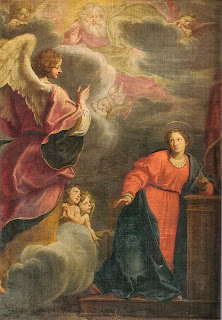 Luke makes it clear that Mary was excited about it, or (twist!) at least a really good faker, as she later says to her cousin, “My soul glorifies the Lord … for he has been mindful of the humble state of his servant.” But think what would have happened if she hadn’t agreed to it. IF she even had a choice in the matter, it was between obedience and, perhaps, going mute or blind until she relented and agreed to give birth to the kid. Before you excommunicate me, Catholic Church, remember what happened to the many others in the Bible who didn’t obey God immediately? Like Zechariah? Adam and Eve? Uzzah, who was struck dead because he reached out to steady the Ark when the oxen stumbled?
All this to say, while listening to the Annunciation story, my carefully watered, Biblically liberal, skipping-Ephesians-4-when-I-read-the-Bible Christianity-in-a-pot began to wither. A part of me had been convinced that, if I focused on the “Jesusy” passages in the gospels, I would get to the heart of what Christianity was, and not have to worry about troublesome things like the sexism all over the Bible. But this isn’t even a passage that you can skip over. This is the story of how Christ was born – it’s kind of important. And even this story is problematic.
For a moment, though, I was able to step out of my anger. As I sat in my chair staring at the pastor, silently boiling and wondering why this had never occurred to me, I realized I was relieved to be offended. It was a good thing that I hadn’t grown completely stony and impassive to this story. All too often, we sit in the pews and let this insane, radical, life-changing stuff bounce off of our seats as if we had force-fields protecting us. We need to let ourselves react, whether it’s in joy or anger or simply confusion. I don’t want to sit in church and think, “That’s nice.” No, it isn’t. If something in scripture makes you uncomfortable, that’s meaningful. Think about it; examine why.
For me, it’s often passages that I see as anti-progressive that make me squirm. And then there’s all the scripture that condemns greed and wealth, verses from Jesus himself that ask us to give away all our possessions to the poor. I dig them, but they don’t exactly make me feel like a saint.
Non-believers have asked me, “If you’re so offended, then why are you still a Christian?” I don’t know. Perhaps I’m a lousy feminist. Or perhaps because there are fundamental human rights that I firmly believe in, and I think God ingrained those beliefs in me, even when they seem to contradict the scripture that makes me believe in God in the first place (yikes!). There are a lot of confusing and offensive passages in the Bible, and I still don’t really know how to think about them. At the same time, there are many other passages that I can get behind, verses like this one from Isaiah: “Learn to do right! Seek justice, encourage the oppressed. Defend the cause of the fatherless, plead the case of the widow.” Yeah!
Luke makes it clear that Mary was excited about it, or (twist!) at least a really good faker, as she later says to her cousin, “My soul glorifies the Lord … for he has been mindful of the humble state of his servant.” But think what would have happened if she hadn’t agreed to it. IF she even had a choice in the matter, it was between obedience and, perhaps, going mute or blind until she relented and agreed to give birth to the kid. Before you excommunicate me, Catholic Church, remember what happened to the many others in the Bible who didn’t obey God immediately? Like Zechariah? Adam and Eve? Uzzah, who was struck dead because he reached out to steady the Ark when the oxen stumbled?
All this to say, while listening to the Annunciation story, my carefully watered, Biblically liberal, skipping-Ephesians-4-when-I-read-the-Bible Christianity-in-a-pot began to wither. A part of me had been convinced that, if I focused on the “Jesusy” passages in the gospels, I would get to the heart of what Christianity was, and not have to worry about troublesome things like the sexism all over the Bible. But this isn’t even a passage that you can skip over. This is the story of how Christ was born – it’s kind of important. And even this story is problematic.
For a moment, though, I was able to step out of my anger. As I sat in my chair staring at the pastor, silently boiling and wondering why this had never occurred to me, I realized I was relieved to be offended. It was a good thing that I hadn’t grown completely stony and impassive to this story. All too often, we sit in the pews and let this insane, radical, life-changing stuff bounce off of our seats as if we had force-fields protecting us. We need to let ourselves react, whether it’s in joy or anger or simply confusion. I don’t want to sit in church and think, “That’s nice.” No, it isn’t. If something in scripture makes you uncomfortable, that’s meaningful. Think about it; examine why.
For me, it’s often passages that I see as anti-progressive that make me squirm. And then there’s all the scripture that condemns greed and wealth, verses from Jesus himself that ask us to give away all our possessions to the poor. I dig them, but they don’t exactly make me feel like a saint.
Non-believers have asked me, “If you’re so offended, then why are you still a Christian?” I don’t know. Perhaps I’m a lousy feminist. Or perhaps because there are fundamental human rights that I firmly believe in, and I think God ingrained those beliefs in me, even when they seem to contradict the scripture that makes me believe in God in the first place (yikes!). There are a lot of confusing and offensive passages in the Bible, and I still don’t really know how to think about them. At the same time, there are many other passages that I can get behind, verses like this one from Isaiah: “Learn to do right! Seek justice, encourage the oppressed. Defend the cause of the fatherless, plead the case of the widow.” Yeah!
 Despite my knee-jerk revulsion to parts of scripture and even some fundamental parts of orthodox Christian faith, I know that I don’t want to believe in a higher power that is just a better version of me. If I’m never challenged by my worldview, if there is nothing in my beliefs that seems sort of contradictory, then I may as well have made it all up. I can’t expect to understand, or even agree with, a being that’s supposed to have existed for all eternity and will continue to do so forever.
I could end with some wise quote from C. S. Lewis or Tim Keller or the book of Job, but I don’t want to. I don’t want anyone to nod along to what I’ve “concluded” and say, “Oh, that’s nice.” It isn’t nice. Faith is anything but nice.
Rebekah Mays is a Barnard College graduate originally from Austin, Texas. She currently works and writes in Prague, Czech Republic. You can find more of her writing on her blog The Prague BLOG or follow her on Twitter @smallbeks.
You might also like:
Despite my knee-jerk revulsion to parts of scripture and even some fundamental parts of orthodox Christian faith, I know that I don’t want to believe in a higher power that is just a better version of me. If I’m never challenged by my worldview, if there is nothing in my beliefs that seems sort of contradictory, then I may as well have made it all up. I can’t expect to understand, or even agree with, a being that’s supposed to have existed for all eternity and will continue to do so forever.
I could end with some wise quote from C. S. Lewis or Tim Keller or the book of Job, but I don’t want to. I don’t want anyone to nod along to what I’ve “concluded” and say, “Oh, that’s nice.” It isn’t nice. Faith is anything but nice.
Rebekah Mays is a Barnard College graduate originally from Austin, Texas. She currently works and writes in Prague, Czech Republic. You can find more of her writing on her blog The Prague BLOG or follow her on Twitter @smallbeks.
You might also like:
 by Ben Howard
This week on the show Ben talks with David Henson about fresh and subversive readings of Scripture. They’ll explore how to read Scripture with a fresh eye, the nature of provocative preaching and what to do with difficult passages in the Bible. We’ll also talk about how David’s kids are obsessed with OK Go videos and his experience being a theology fan boy.
Be sure to follow David on Twitter and check out his blog Edges of Faith.
If you like the show, please rate and
review us on iTunes. It's the first step in our secret mission to take over the world.
by Ben Howard
This week on the show Ben talks with David Henson about fresh and subversive readings of Scripture. They’ll explore how to read Scripture with a fresh eye, the nature of provocative preaching and what to do with difficult passages in the Bible. We’ll also talk about how David’s kids are obsessed with OK Go videos and his experience being a theology fan boy.
Be sure to follow David on Twitter and check out his blog Edges of Faith.
If you like the show, please rate and
review us on iTunes. It's the first step in our secret mission to take over the world.
You can download the podcast by clicking here.
Or you can subscribe to the podcast by searching "On Pop Theology" in
the iTunes music store.
Also, remember to "Like" On Pop Theology on Facebook and follow us on Twitter @OnPopTheology for all the updates, posts, and links throughout the week.
Finally, if you'd like to stream the podcast, you can do that here:
Peace,
Ben
If you have any questions, comments, or if you just want to say hi, you can contact us at onpoptheology [at] gmail.com.
You might also like:
by Ben Howard
There's a lot of misinformation in the world today. Some argue that's simply the nature of the internet and the democratization of information itself. A lot of websites exist to fight the good fight and attempt to right these factual wrongs and a well-informed public is thankful for them.
However, we're not one of those websites. So with the fundamental ethos of the internet in mind, we bring you A Series of Outright Lies About the Bible
1) Contrary to popular belief, the best way to absorb the Bible is through osmosis. Try placing a Bible under your pillow at night, or sitting on one during your daily commute.
2) All leather used in the making of leather-bound Bibles comes from a
yearly ritual sacrifice performed on the Isle of Wight by the Knights
Templar. This year Stephen Baldwin officiated at the ceremony and music
was provided by noted jam-band the Spin Doctors.
3) Do not lick the pages of your Bible. Don't ask questions. You've been warned.
4) Various Biblical names translated into English:
- Ananias - to blathe, which is like bluffing in poker
- Timothy - a man named Timothy
- Titus - a vulgar word for shoe
- Thomas - Matthew Broderick
- Jeremiah - in the infinitive form: to sing an endless string of Morissey lyrics
5) All Psalms are written to be sung to the tune of "Tubthumping" by Chumbawumba, but set in a minor key.
6) In 1982 Stephen Sondheim reportedly optioned the rights to the Book of Leviticus for an future musical adaptation. When asked several years later about when the work would debut, Sondheim angrily retorted that the world wasn't ready for his masterpiece and announced that the play would not debut until he was resurrected from cryogenic slumber in April 2312.
 7) According to legend, 16th-century French monks believed the genealogies to be the key in finding the elusive Fountain of Youth. But since they're not around today, they look pretty stupid. #Face
8) The Bible 2, a cinematic sequel to the original best-selling book, was released in 1977, but was universally panned by critics for it's unoriginal plotline and poor performances from a young Michelle Pfeiffer and Jim Vatrolta, a well-known John Travolta impersonator. However, Wilford Brimley's portrayal of the Devil served as the inspiration for Kevin McCallister in Home Alone.
9) After several instances of wild, rampaging Bibles mauling acolytes during the Byzantine empire, priests began the practice of chaining Bibles to the lectern for their own safety. Many priests were also lauded for their exemplary skills at "Bible whispering".
Peace,
Ben
Ben
Howard is an accidental iconoclast and generally curious individual
living in Nashville, Tennessee. He is also the editor-in-chief of On Pop
Theology and an avid fan of waving at strangers for no reason. You can
follow him on Twitter @BenHoward87.
You might also like:
 by Ben Howard
This week Ben, Jesse and Sebastian talk about whether or not America is a
Christian nation. We'll discuss the assumptions we grew up with, the
conflation of American values with Christian values, and why believing
America is a Christian nation makes the Revolutionary War ironic. There
will also be references to The Giving Tree and Care Bears. Finally,
you'll join us as we quiz Christian college students in a game called
"Ben Franklin or The Bible".
If you like the show, please rate and
review us on iTunes. It's the first step in our secret mission to take over the world.
by Ben Howard
This week Ben, Jesse and Sebastian talk about whether or not America is a
Christian nation. We'll discuss the assumptions we grew up with, the
conflation of American values with Christian values, and why believing
America is a Christian nation makes the Revolutionary War ironic. There
will also be references to The Giving Tree and Care Bears. Finally,
you'll join us as we quiz Christian college students in a game called
"Ben Franklin or The Bible".
If you like the show, please rate and
review us on iTunes. It's the first step in our secret mission to take over the world.
You can download the podcast by clicking here.
Or you can subscribe to the podcast by searching "On Pop Theology" in
the iTunes music store.
Also, remember to "Like" On Pop Theology on Facebook and follow us on Twitter @OnPopTheology for all the updates, posts, and links throughout the week.
Finally, if you'd like to stream the podcast, you can do that here:
Peace,
Ben
If you have any questions, comments, or if you just want to say hi, you can contact us at onpoptheology [at] gmail.com.
You might also like:


